Plastoline!

30 months ago, I wrote about alternative fuels. See It’s a Gas, Man! At the time it seemed like the world was transitioning from gasoline-powered cars to electric cars and the expectation was that the demand for gasoline would begin to drop. Additionally, there was another wholesale shift taking place in the automotive world: zero emissions cars.
Just to recap, here are some of the alternative fuels that would make a gasoline-powered car zero emissions:
ExxonMobil has a method to manufacture synthetic gas. The process synthesizes methanol into gasoline. Methanol can be created out of carbon dioxide and hydrogen. Hydrogen can be created from water (the H2 in H2O) via electrolysis and carbon dioxide can be extracted from the air.
Porsche has a test facility that uses a windmill to generate electricity that is used to create hydrogen from water. The hydrogen is combined with carbon dioxide from thin air to create methane that is then converted into gasoline.
Audi learned how to synthesize diesel fuel from water! Basically, water is heated to 800 degrees Celsius, creating steam. The high temperature breaks the water into oxygen and hydrogen. The hydrogen is combined with CO2 from the atmosphere and, under high heat and pressure, synthesizes to create a liquid they call “blue crude.” The blue crude is refined into what Audi calls e-diesel.
So, what’s new now?
Julian Brown, a 22-year-old inventor from Duluth, Georgia uses a process called microwave pyrolysis, powered by solar panels, to convert plastic into fuel. The vaporized petroleum is condensed back into liquid crude oil, which Brown says can then be refined into gasoline, diesel and jet fuel alternatives.
Brown, a self-taught inventor, began experimenting with the technology as a teenager and has shared videos on platforms like TikTok and Instagram demonstrating small-scale tests where he heats plastic waste (e.g., bottles and bags) in a makeshift reactor to produce the fuel.
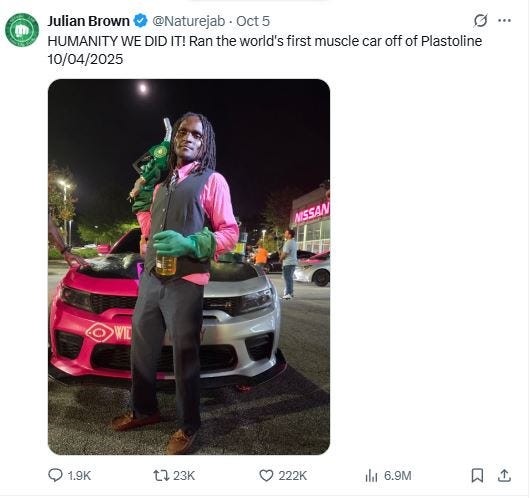
Brown tested his Plastoline fuel last week at a Nissan dealership in Duluth, where he gassed up a Dodge Scat Pack.
Here’s a link to the video of the demo:
Yes, Plastoline is real in the sense that Brown has successfully produced a fuel-like substance from plastic waste in controlled, small-scale experiments, and independent analyses confirm it contains gasoline-like compounds. Videos show it powering engines, and he’s shared lab results claiming lower emissions than traditional gasoline.
While a tremendous amount of credit goes to Brown for his work and for raising the visibility of this technology, Plastoline is not a groundbreaking invention—pyrolysis for plastic-to-fuel has been around since the 1970s, with numerous patents and pilot projects worldwide.
Existing pyrolysis plants (for example in India and Japan) can process 10-100 tons of plastic per day and have been operational since the 2010s. These plants produce fuel for local markets. However, global capacity is tiny (~1% of plastic waste) and is mostly held back by economics.
One company, Klean Industries has plastic recycling plants in The Philippines, Malta, Thailand, Canada, Germany, Japan and the U.S. The company claims that it’s technology can produce light to medium synthetic oil at an incremental cost of $10 per barrel, or about $0.24 per gallon.
Humans use about 1.2 million plastic bottles per minute. Approximately 91% of plastic is not recycled and roughly half of our global annual plastic production is destined for a single-use product. So, there’s plenty of raw material.
According to Brown, the inventor’s work is just beginning. “I see it now as, let’s get it in the world and implemented. That’s the whole point of why I started this.”
It sounds like Plastoline has a promising future. Mr. Brown too.